

It Makes Me So Angry!
- Feb 20
- 4 min read
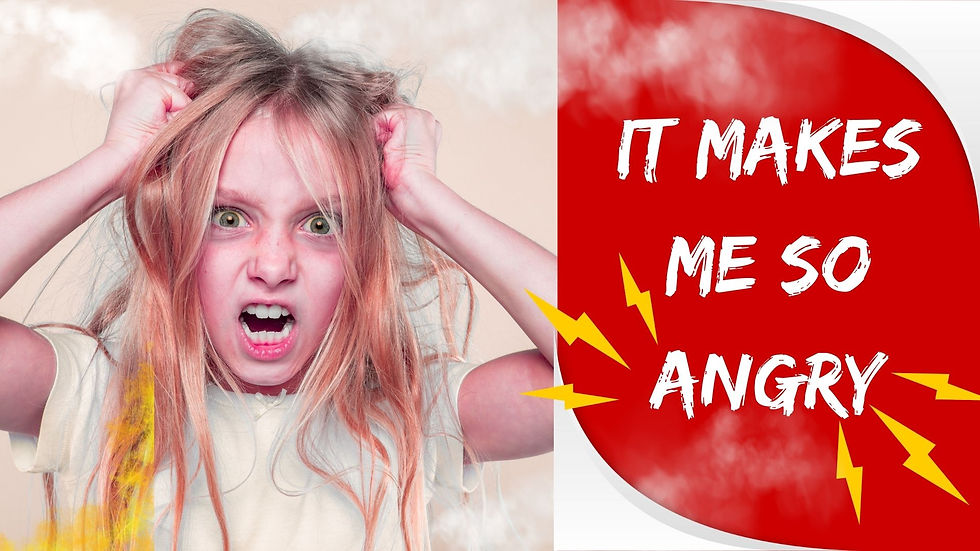
How would you finish this sentence?“It makes me so angry when…”
We all have our pet peeves—irritations we find particularly irksome. My list includes erratic, distracted drivers who threaten the safety of others. Just last week, I encountered a car driving towards me the wrong way on a one-way street. Or, how about those maddeningly ineffective customer service bots? When the neighbor dug up our Fios cable, it was twenty minutes before the bot FINALLY connected me with an agent. It’s natural to get angry, we reason. After all, who wouldn’t find those situations infuriating?
But what if I told you that anger is a choice? The truth is no one can force us to feel anything. When we attribute our feelings to other people or situations, we are choosing to abdicate our personal power. As Eleanor Roosevelt famously said, “No one can make you feel inferior without your consent.”
In Viktor Frankl's seminal book, Man's Search for Meaning, and reiterated by Stephen Covey in The Seven Habits of Highly Effective People, we are reminded that between stimulus and response, there is a space. In that space, we choose how we will respond. As Frankl points out, "In our response lies our growth and our freedom." In describing our ability to choose, Covey coined the term response-able.
We often don’t notice that space unless we look for it. Instead, we react on autopilot, repeating behaviors we’ve practiced many times before. It takes intention to use the gap to our advantage—to pause and choose something kinder and more compassionate.
The monks on the recently completed Walk for Peace demonstrated response-ability in real time. Despite the harsh weather—and harsh words—they encountered along their journey, they unfailingly responded consistently with loving kindness.
Emotions Affect Our Health
Changing behavior isn’t easy, but it is simple. It begins with identifying your why—your reason for wanting to change.
One powerful reason is health: yours and the well-being of those around you. Our emotions generate electromagnetic signals that affect every system in the body, influencing heart rate, blood pressure, and even our ability to think clearly. Chronic anger has been linked to increased risk of heart attack and stroke, digestive issues, lowered immunity, and fatigue.
We also broadcast our emotional state into the space around us. Most of us have felt the discomfort of being near an angry person. If we permit it, their emotional dysregulation can become disrupt our serenity through emotional contagion.
On the flip side, being around someone calm can help us feel more peaceful. Experiments conducted by the HeartMath Institute have shown that people's systems go into coherence when in the proximity of coherent individuals.
Techniques to Cultivate Emotional Regulation
Emotional self-regulation isn’t about getting it “right.” It’s about becoming more aware, more intentional, and more compassionate along the way. Some days I pause and choose wisely. Other days, I react and learn afterward. Here are some techniques to strengthen your response-ability.
The monks rely on hours of daily meditation to cultivate abiding inner peace. Meditation is powerful, but you don’t need to sit for hours to benefit. Start with just a few minutes a day and notice how you feel.
You are invited to join my free weekly Intend Peace gatherings. It's a way to set aside a few minutes a week to cultivate inner peace by meditating with others.
Sometimes we’re already too keyed up to sit still. In those moments, a simple breathing practice can help regulate the nervous system. Just a few minutes of slow, intentional breathing can shift your state. You may want to experiment with my guided breathing practice videos.


I begin each day with a simple reminder:“I am the keeper of my body and my mind. I choose what to let in.” Then, when negativity creeps in, I ask myself whether that’s truly what I intend to feel. This is not to say that we should suppress anger, but we can, instead, be mindful of releasing emotion that is not serving us.
If you notice recurring triggers—situations that reliably get a rise out of you—approach them with curiosity. Ask yourself why they affect you so strongly. Journaling can be a powerful tool for this kind of self-exploration, especially after some time has passed and you can reflect calmly. I’ve learned a great deal about myself this way, and the awareness makes it easier to interrupt old patterns.
In Breaking the Habit of Being Yourself, Joe Dispenza recommends mental rehearsal to rewire automatic responses. Imagine a situation that typically causes frustration. Then picture yourself responding with kindness and compassion instead. Make the scene as vivid as possible—what you see, hear, and feel. This kind of rehearsal helps create new neural pathways.
When you feel anger arising, pause. Take a deep breath and remind yourself: you have the power to choose. When we learn to regulate our emotions, we reclaim our inner authority. We stop surrendering our peace to circumstances and begin living from intention instead of reaction.
This week, notice the space between stimulus and response. See if you can catch even one moment where you pause and choose differently. Small shifts create powerful change. And every calm response is a gift—to your body, your mind, and the people around you.
Remember: just like learning to play a musical instrument, emotional regulation improves with practice. We are all works in progress—never complete, never perfect, always becoming.
The world is chaotic—but that external discord doesn’t mean our inner life has to be tumultuous as well. We can choose to be the calm in the storm.


Comments